
The Things We Keep
You have more ancestors than you can imagine. Two parents. Four grandparents. Eight great-grandparents. Keep doubling backwards and, sixteen generations ago, your family tree opens out into 65,536 ancestral positions.1 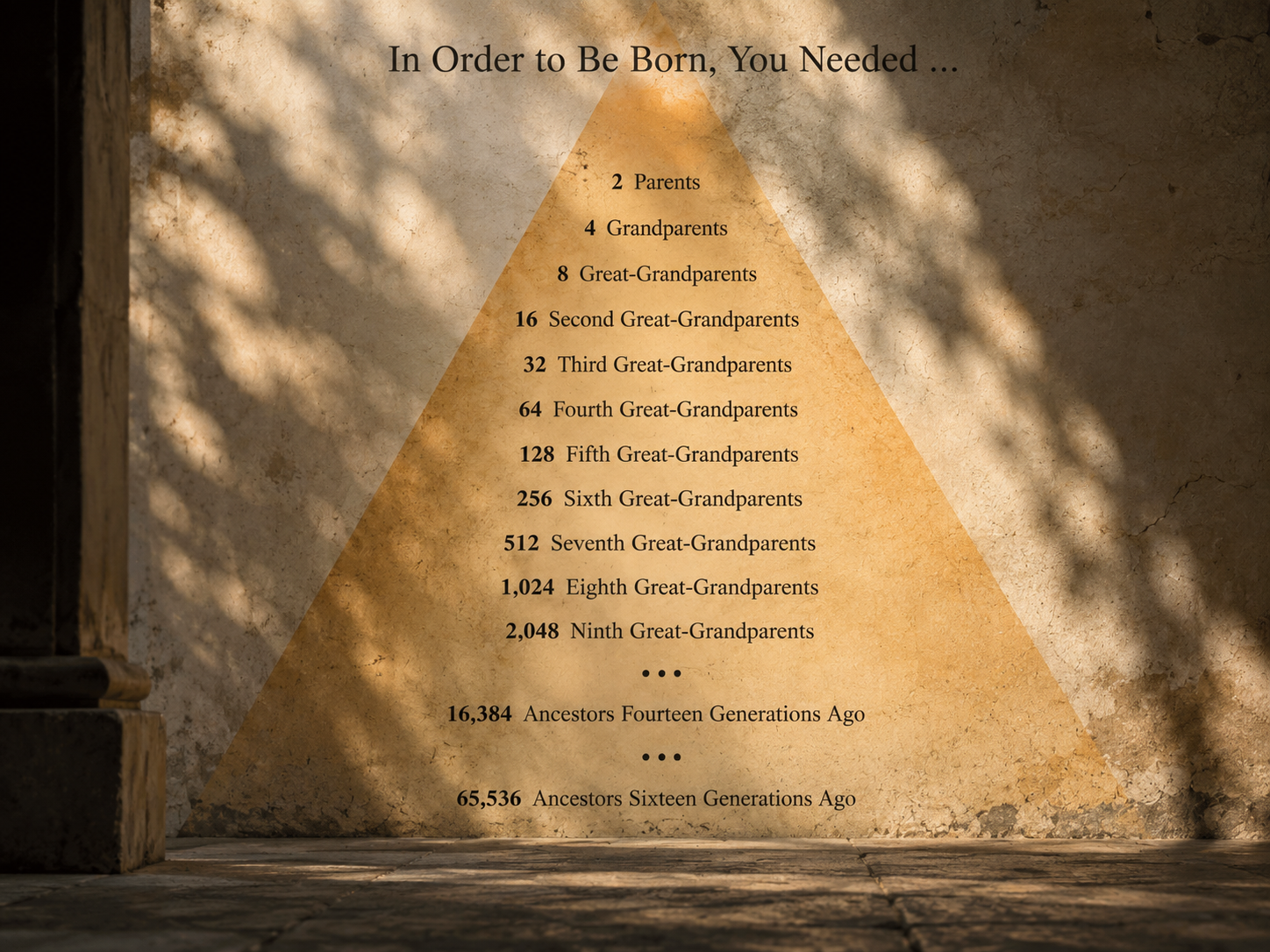 Two parents become four grandparents, eight great-grandparents, and so on. Sixteen generations produce 65,536 positions in a theoretical family tree.
Sixteen generations sounds ancient. It isn’t. Hyderabad was founded in 1591 by Muhammad Quli Qutb Shah. The Charminar dates from the same year. 435 years separate us from the people who stood in its shadow when the stone was new. That is only about fourteen to sixteen generations.2
Someone survived a fever. Someone crossed a river and never went back. Someone married the wrong person. Someone married exactly the right one. There must have been quarrels that lasted years, children who refused to listen, debts, betrayals, accidents, journeys, famines, births, deaths, small kindnesses, and thousands upon thousands of entirely ordinary mornings. One broken chain anywhere along that bewildering sequence and you would not be sitting here reading this.
Most of their names are gone. But their world isn’t. We walk through bits of it every day — an old street, a step worn shallow in its centre, a wall that has survived three buildings around it, a tree whose planter has long since disappeared beneath its roots.
Some of these things we call heritage.
But Not Everything Can Stay
I don’t think old things deserve to survive merely because they are old. We cannot preserve everything, nor should we. A city that refuses to lose anything eventually loses its ability to change.
So we choose. We save one building and allow another to disappear. We restore a palace, preserve a market, fight over an old house. Inevitably, we begin reaching for words such as important, historic, rare, beautiful.3
But I am not sure that these words quite explain why some old places get under our skin.
Because sometimes what stays with us is embarrassingly insignificant.
The Things We Recall
When I recall the buildings I knew as a child, they rarely return as an architect would document them. They don’t return as elevations or plans. They return as fragments: the cold floor of a temple, fallen leaves on a courtyard floor, the smooth turn of an old wooden handrail.
I remember the cold floor of a temple. Not the plan of the temple. Not its elevation. I cannot tell you the dimensions of the mandapa. What I remember is taking off my footwear outside, walking in from the heat, and placing my bare foot on stone.
Cold.
Not unpleasantly cold. A comfortable cold — dense, slightly damp perhaps, withdrawing heat from the sole of the foot. The light outside is still sitting in your eyes, so for a few moments the interior appears darker than it really is. You slow down without being told to.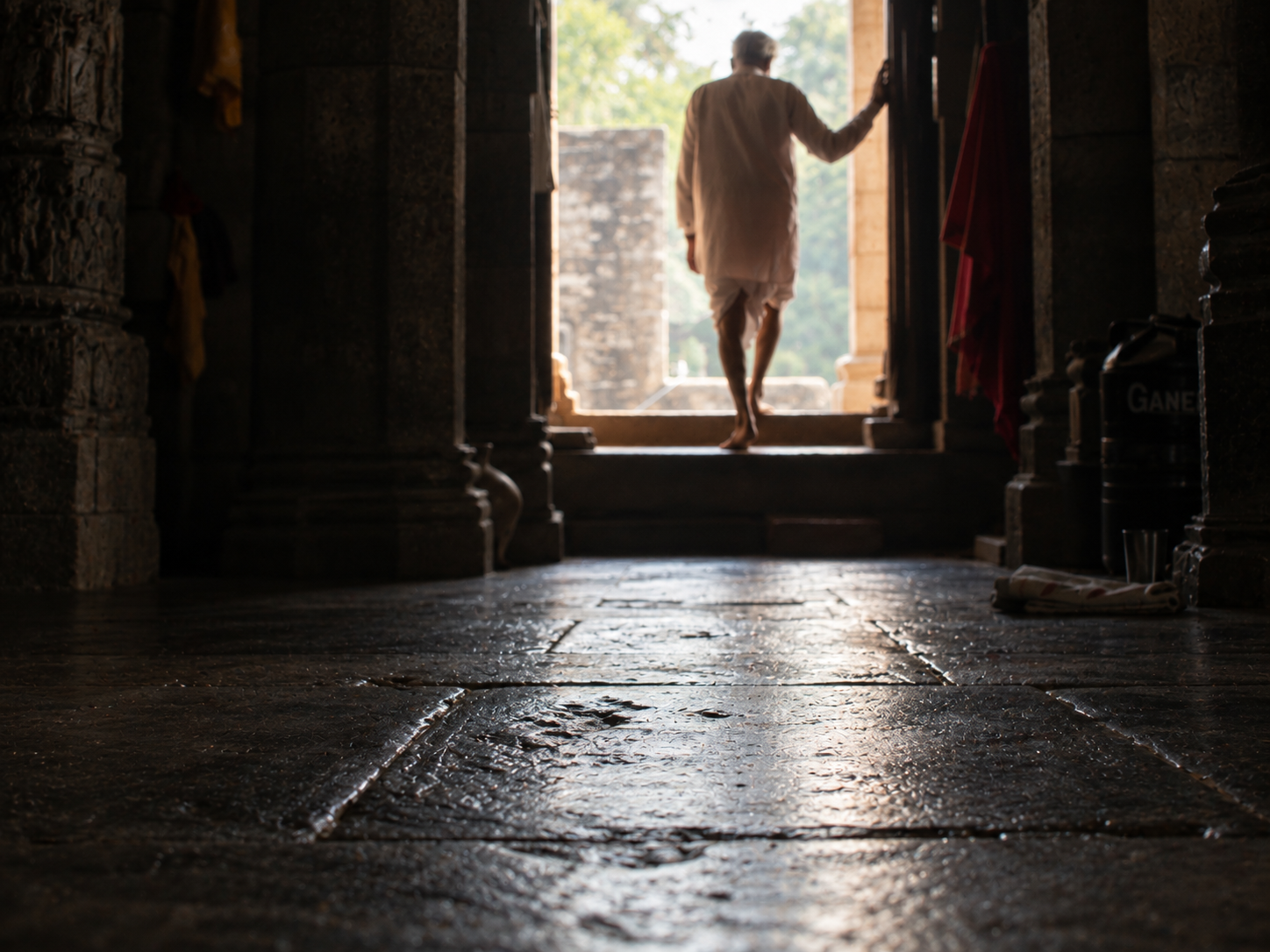
I remember fallen leaves on courtyard floors. Not swept into a picturesque pile, but lying where they fell — some crisp, some damp, some reduced to the dark stains they leave behind after rain.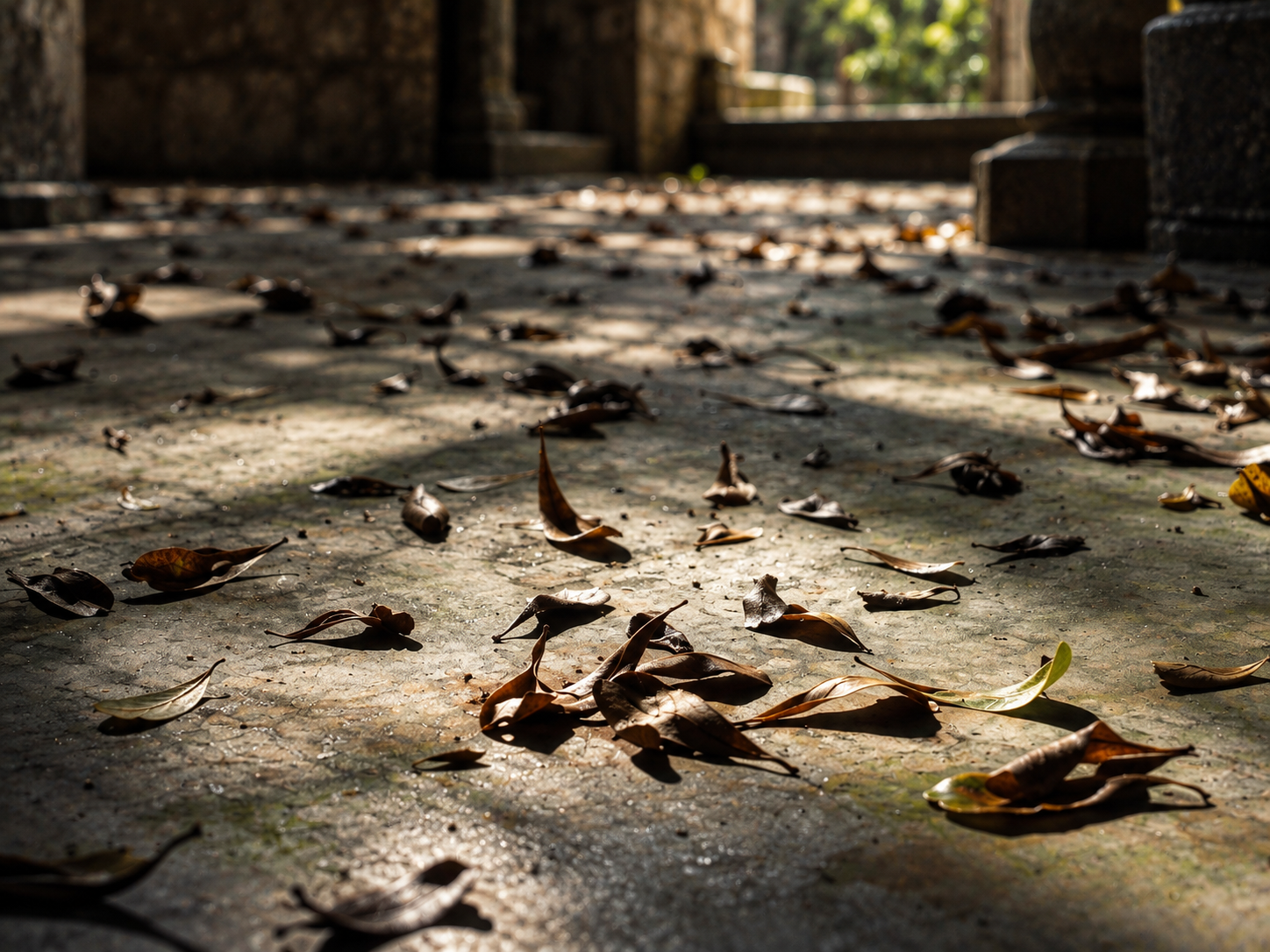 Wind-blown leaves on a courtyard floor
I remember old wooden handrails. At the turn, where the hand instinctively grips harder, the timber changes. It becomes smoother, darker, almost oily. Nobody designed that finish. Thousands of palms did.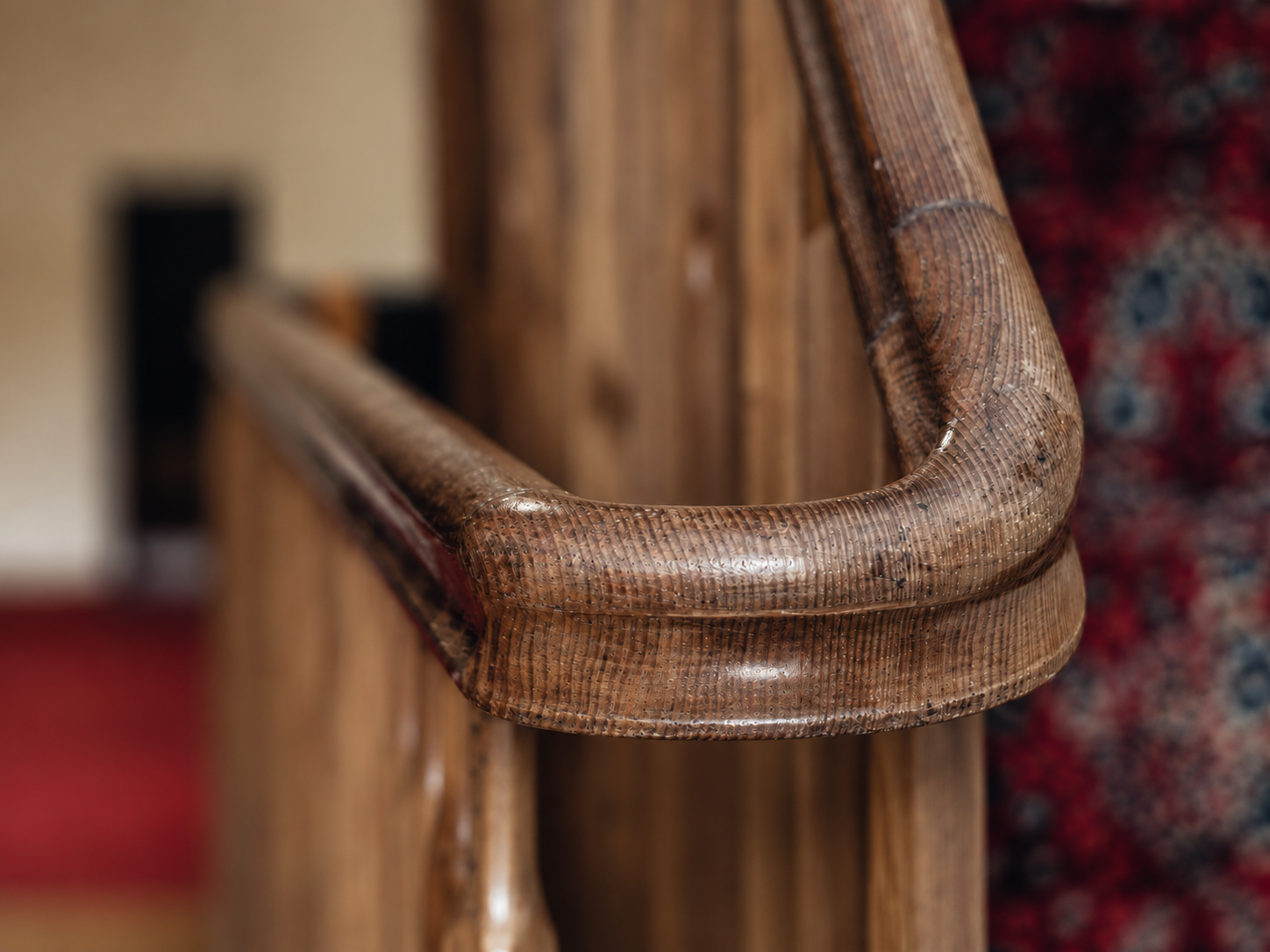 Old wooden handrail polished by repeated touch. Some finishes are specified. Others take decades of hands.
And I remember old wooden staircases that creak. Every house seems to have its own vocabulary of creaks. After living with one long enough, you can sometimes tell that somebody is coming before you see them. Perhaps even who. 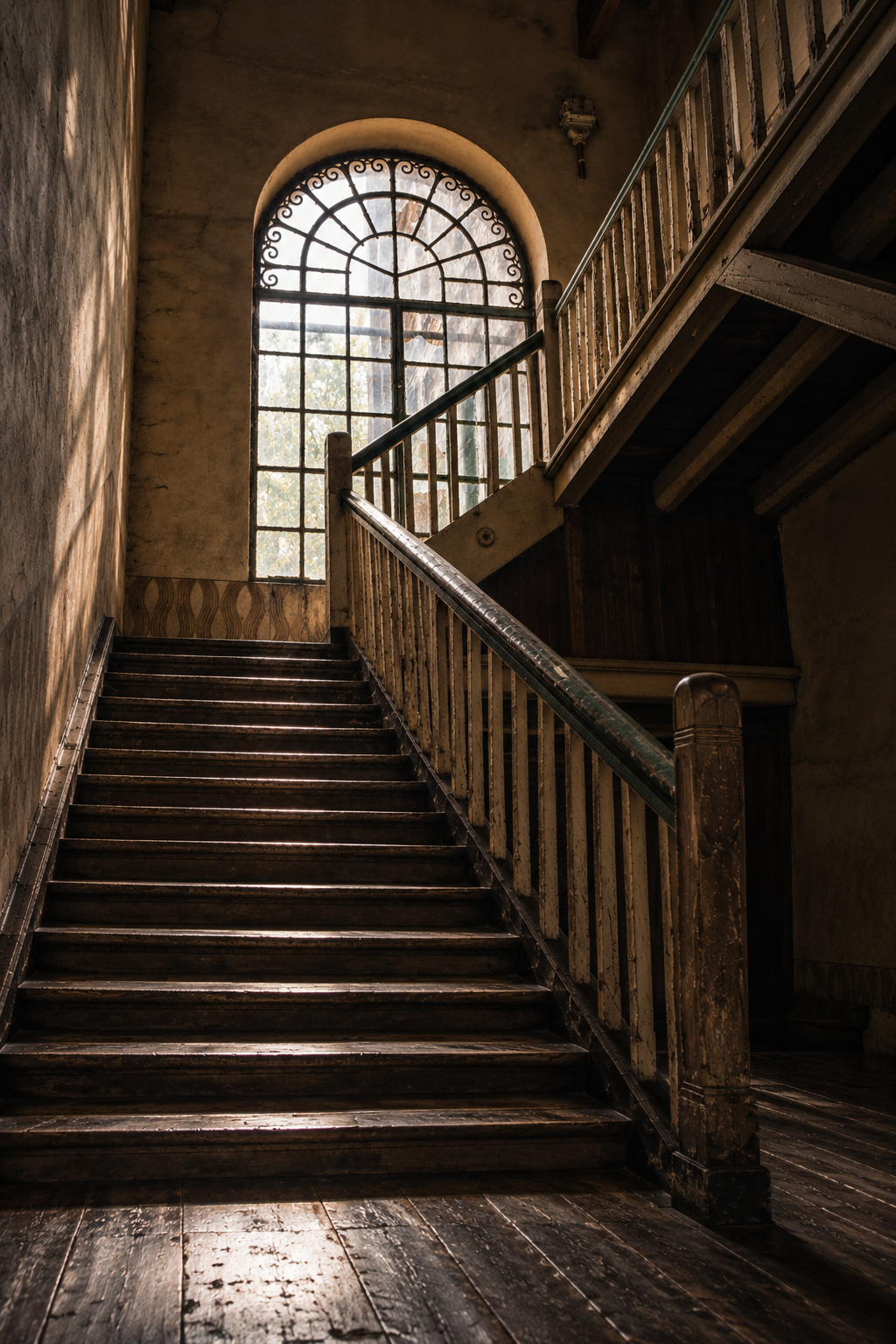 A creaky staircase floor. Sometimes architecture announces a person before they enter the room.
None of this is important architecture. A fallen leaf is not architecture at all. Yet these things cling to memory with extraordinary stubbornness.
I still remember the feel of my grandmother’s sari. It was a particular cotton, soft in a way that I have never quite been able to describe. As a child I knew nothing of its weave or provenance. I knew only the sensation of it against my cheek and what that sensation meant.
Years later, another piece of similar cloth can suddenly bring some part of her back. Her embrace. The cloth has done almost nothing. Memory has done the rest.
Spaces can do this too.
Inhabiting Spaces
We draw buildings before people get to them. Lines are straight. Stone is unworn. Timber has an even finish. The photograph is taken before somebody hangs the wrong curtain.
Then life gets at it.
A chair is dragged repeatedly across one part of the floor. Someone drives a nail into the wall because that is exactly where the calendar must hang. The monsoon finds the weakness in a window. Children discover that a parapet is actually a seat. A brass handle darkens everywhere except where fingers touch it. The family dog scratches the bottom of a door. Somebody plants a sapling in a courtyard and, forty years later, the architecture has to negotiate with a tree.
This is not damage in the ordinary sense. Or at least, not all of it is. It is evidence.
Architecture is exposed to life. Heritage is architecture exposed to time.
Time does not merely make architecture old. It allows life to accumulate upon it. And life is messy. It stains marble. It leaves a faint rectangle on the wall where a photograph once hung. It produces smells that were never in the bill of quantities and sounds that were certainly not in the drawings. A floorboard develops a creak. A stone step slowly yields beneath thousands of feet.
We usually photograph architecture just before all this begins.
Perhaps we photograph it too early.
Beauty, Not Skin Deep
We often speak of preserving beautiful buildings as though beauty were sitting patiently inside the object, waiting for somebody qualified enough to recognise it. I doubt it is that obedient.
A heritage building does not become meaningful simply by surviving. Meaning accumulates around it — through use, association, memory and time. A building can certainly be beautiful because of proportion, material or craftsmanship. But another kind of beauty creeps in through familiarity. Through use. Through association. Through knowing where the afternoon sun will fall in December. Through remembering that your grandfather always sat in that corner. Through a stain on the wall that everyone else sees simply as a stain. 4
So the question Is this building beautiful? may sometimes be less useful than another one:
What does this building allow us to recall?
Strip the old paint. Replace the uneven stone. Sand the handrail back until the timber looks new again. The result may be immaculate. It may even be magnificent.
And yet the hands are gone.
We have preserved the timber and removed the touch.
What Do We Choose to Keep?
Perhaps this is the uncomfortable part of conservation: we can preserve the object and still lose the thing that mattered.
A courtyard is not merely its dimensions and paving. A temple is not its plan. A house is not its façade. These are containers into which life keeps spilling — smells from kitchens, arguments from bedrooms, rain into courtyards, footsteps on stairs, rituals repeated until nobody remembers quite when they began.
Slowly, the building becomes entangled with the people who inhabit it. Stone remains stone. Timber remains timber. But these materials begin to carry things with no material weight: memory, familiarity, loss, affection. Sometimes pain.
Perhaps this is why entering a very old building can feel different even before we know its history. Its surfaces have been touched by lives we cannot see. Its steps have been negotiated by feet whose owners have disappeared. Its rooms have outlived the voices that once filled them.
Four hundred years is an abstraction.
A worn step isn’t.
That is what time does to architecture. It gives memory somewhere to reside.
And perhaps that is what we are really deciding when we decide what to conserve: not what deserves to remain old, but what we are unwilling to stop remembering.
⌽ This essay grew out of a TEDx talk I gave on heritage, memory and conservation. It has since been revisited, expanded and, inevitably, changed.A theoretical biparental genealogy doubles with each generation: 2^16 = 65,536 ancestral positions. Real genealogies overlap through pedigree collapse, so these are positions, not necessarily distinct individuals. Buffalo, Mount & Coop, “A Genealogical Look at Shared Ancestry on the X Chromosome,” Genetics 204(1), 2016. ↩︎
Hyderabad and the Charminar date to 1591: 435 years before 2026. At roughly 26–30 years per generation, that is about 14–17 generations. Government of Telangana; Wang et al., Science Advances 9(1), 2023; Moorjani et al., PNAS 113(20), 2016. ↩︎
The Burra Charter locates cultural significance not only in physical fabric, but also in setting, use, associations and meanings — and recognises that these values may change over time. Australia ICOMOS, The Burra Charter, 2013, Art. 1.2. ↩︎
The Nara Document rejects fixed criteria for heritage value and authenticity, recognising sources beyond form and material: use, tradition, setting, and “spirit and feeling.” The Nara Document on Authenticity, 1994, §§9–13. ↩︎
